White noise for babies: safe volume, distance and when to stop
What the research says about white noise for babies: how loud is too loud, how far from the crib, why nothing goes in the crib, and how to wean off it.

On this page
This article is general information, not medical advice. If sleep, hearing or a health problem worries you, talk to a doctor or audiologist.
White noise for babies is generally fine when it’s quiet, far from the crib, and not running at full volume all night. The evidence that it helps is modest but real: in a small 1990 trial, 80% of newborns fell asleep within five minutes with white noise, against 25% without it. The risk comes from loudness. A 2014 study in Pediatrics found that every infant sleep machine it tested, at maximum volume and 30 cm away, was louder than the noise limit recommended for hospital nurseries.
So the practical rules are short: keep the sound source well away from the crib (never in it or clipped to it), use the lowest setting that still masks the household noise, prefer a timer over all-night play, and keep cords out of reach. The rest of this article explains where those rules come from, what the studies measured, and what they didn’t.
If your baby has trouble sleeping or you’re worried about hearing, your pediatrician is the right person to ask. White noise is a convenience, not a treatment.
What the research actually measured
The 2014 Pediatrics study on infant sleep machines
The study most often cited is Hugh and colleagues, “Infant sleep machines and hazardous sound pressure levels,” from the otolaryngology department at the University of Toronto. The team tested 14 infant sleep machines sold in the US and Canada, played at maximum volume, and measured them at three distances: 30 cm, 100 cm and 200 cm (about 1, 3 and 6.5 feet). They used correction factors to account for the ear canal of a six-month-old, which is smaller than an adult’s and changes how sound arrives at the eardrum.
The results:
| Distance from machine | What they found at maximum volume |
|---|---|
| 30 cm (about 1 ft, like a crib rail) | All 14 machines exceeded 50 dBA; 3 exceeded 85 dBA |
| 100 cm (about 3 ft) | All 14 still exceeded 50 dBA |
| 200 cm (about 6.5 ft) | 13 of 14 still exceeded 50 dBA |
Two reference points matter here. 50 dBA is the recommended noise limit for infants in hospital nurseries, the benchmark the authors chose. 85 dBA over 8 hours is the level at which adult workplace rules start to worry about hearing loss. Three machines, close to the baby, went past even that.
The authors’ advice to parents, as reported by NBC News at the time: run the machines as quietly as possible, as far from the baby as possible, and for as short a time as possible. They also asked manufacturers to lower maximum volumes, add automatic shut-off timers and print hearing warnings.
What the study did not show matters just as much. It measured what the machines can do at full volume. It didn’t look at how parents actually use them, and no study has followed babies exposed to these machines to check their hearing. “Capable of harm at maximum” is not the same as “harmful as typically used.”
A newer test that included phone apps
A 2021 study in the International Journal of Pediatric Otorhinolaryngology (Hong et al.) tested 8 infant white noise machines and 6 iPhone apps at their lowest and highest settings, at 10 cm (inside a crib), 30 cm (just outside the rail) and 100 cm (a nightstand across the room).
At the lowest setting, no device exceeded 85 dBA at any distance. At the highest setting, 9 of the 14 devices exceeded 85 dBA at 10 cm. Nothing exceeded 85 dBA at 30 or 100 cm. Note that this study used the adult occupational threshold (85 dBA), not the stricter 50 dBA nursery figure, so “didn’t exceed 85” doesn’t mean “quiet enough for a baby.” Its authors recommend avoiding the maximum setting and keeping any device well outside the crib.
The takeaway for parents using a phone: phones and apps belong in the same category as dedicated machines. A phone at full volume next to a baby’s head is the scenario every study warns about.
What a 2024 review added
A 2024 scoping review in Sleep Medicine (De Jong et al.) pulled together 20 studies on continuous noise during sleep and early development: 7 in animals and 13 in children. Some machines topped 91 dB at maximum. Animal studies suggest that continuous moderate-intensity noise can affect early auditory development; human data broadly point the same way, though some studies suggest low-intensity noise during sleep may be beneficial. The authors concluded that the evidence supports limiting both the maximum loudness and the duration of these devices, and that more research is needed on safe levels for children.
That’s a fair summary of where things stand: low and short looks reasonable, loud and constant is where the concern sits, and nobody has precise thresholds yet.
What the AAP says
We couldn’t find an American Academy of Pediatrics policy specific to sound machines, or a decibel figure for them on its parent site HealthyChildren.org. You’ll often see “at least 7 feet away” attributed to the AAP; we couldn’t find that number in AAP materials, and it most likely traces back to the 200 cm distance in the 2014 study.
What the AAP does say clearly applies to any device in the nursery. Its 2022 safe sleep policy statement and HealthyChildren.org’s parent guide call for a firm, flat, bare sleep surface, and the guide puts it plainly: use a fitted sheet only, and nothing else should be in the crib with your baby. That includes sound machines, plush toys with speakers, and phones. The AAP also recommends room sharing (baby in their own crib or bassinet in your room) for at least the first six months, which matters here because a sound machine in a shared room is often on the parents’ nightstand, close to the crib.
How to use white noise safely
Distance: outside the crib, as far as practical
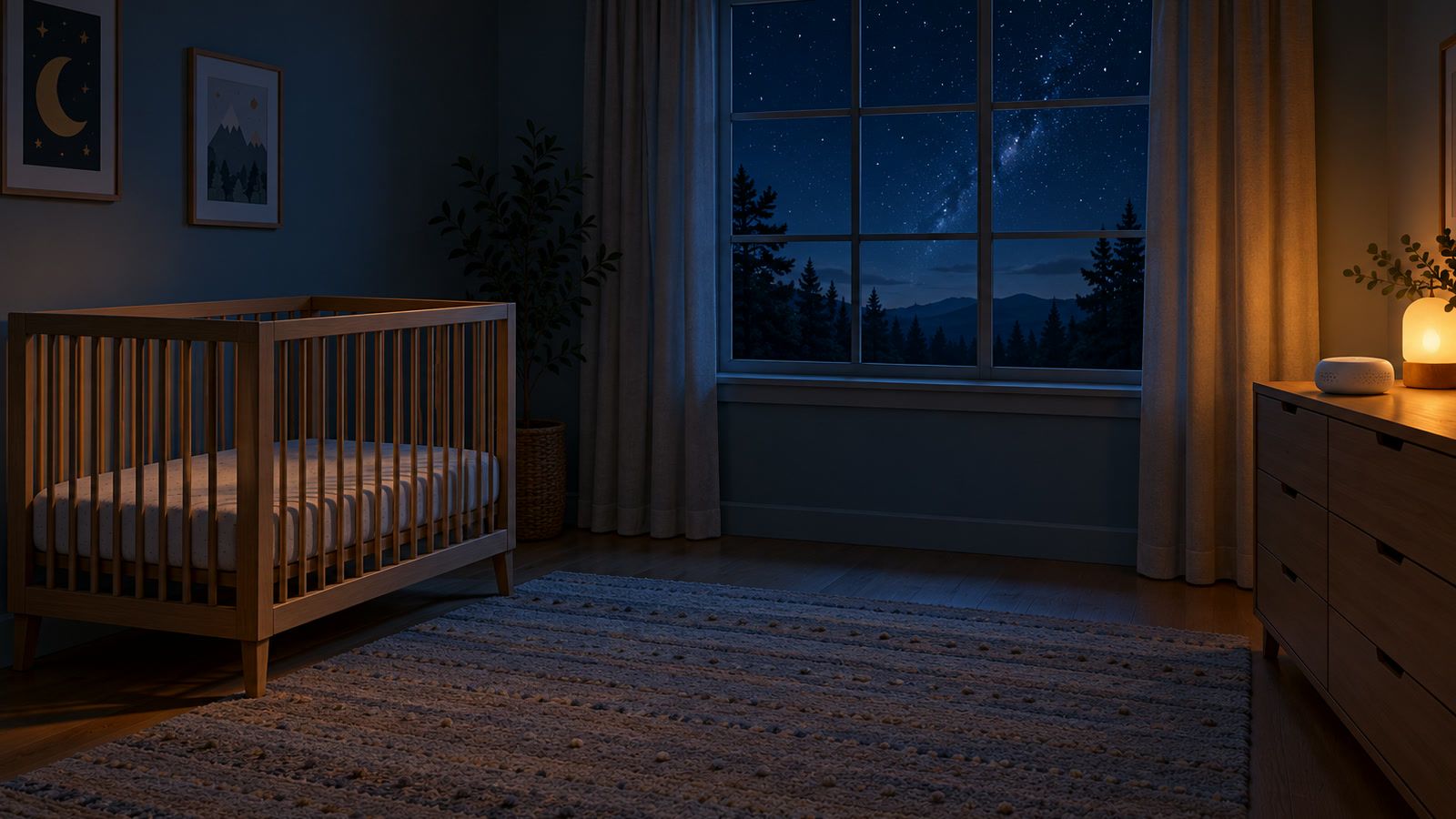
Put the speaker across the room or at least several feet from the crib, never inside it, never strapped to the rails, and never on a shelf where it could fall in. The 2014 data shows that distance alone doesn’t solve loudness (13 of 14 machines still exceeded 50 dBA at 200 cm on maximum), so distance and low volume work together.
Cords are a separate hazard. The US Consumer Product Safety Commission advises keeping baby monitors and their cords at least 3 feet from the crib because of strangulation risk. Apply the same rule to sound machine cables and phone chargers. If your phone is the sound source, it should sit on a dresser or shelf with the charging cable fully out of reach, not on the mattress or the crib edge.
Volume: aim for around 50 dBA at the crib
The 50 dBA nursery limit is the only concrete benchmark the research offers, so it’s a sensible ceiling. That’s a soft, steady hush, clearly quieter than a normal conversation. A practical way to set it:
- Start the sound at its lowest setting, then raise it only until it covers the noise you’re trying to mask (traffic, a dog, siblings).
- Measure at the crib, where your baby’s head is, not next to the speaker. Free sound meter apps are not lab instruments, but they’re good enough to tell 50 from 70. The 2021 study itself used the NIOSH Sound Level Meter app for iPhone.
- Never use the maximum setting, on a machine or a phone.
If you have to raise your voice to talk over the sound while standing at the crib, it’s too loud.
Duration: timer first, all night only if you need it
The 2014 authors suggested using sleep machines for as short a time as possible. The simplest way to follow that is a timer that covers the time it takes your baby to fall asleep, then fades out. Some families find that all-night sound helps with early-morning street noise or a sibling’s alarm; if you go that way, keep it at the low end and keep the distance. There is no study defining a safe number of hours for infants, which is a good reason to stay conservative rather than a reason to panic.
Which sound to choose
There’s no evidence that one noise color is safer or better for babies than another. What matters is the level. Softer, lower sounds like pink or brown noise feel less harsh to many adults at the same volume; you can read about the differences in white, pink and brown noise explained. Rhythmic sounds such as a heartbeat or a “shush” are popular because they resemble what babies heard in the womb, but that’s a parenting tradition rather than a tested finding.
In Noctune (coming soon to iPhone and Android) you can play a shush, a heartbeat recorded through a stethoscope (40 to 100 BPM), a music-box lullaby or plain noise, with a separate volume for each sound, a maximum-volume cap in Settings and a sleep timer that fades out slowly. The same rules apply: phone across the room, cable out of reach, volume low.
When to stop using white noise
There’s no official age to stop, and the studies above didn’t look at weaning at all. Families stop for practical reasons: travel, a toddler who no longer needs it, or simply wanting a quieter night.
A gentle way to wean:
- Lower the volume a little every few nights over one to two weeks.
- Or shorten the timer step by step until it only covers the first minutes of sleep, then drop it.
- Keep the rest of the bedtime routine the same so the sound isn’t the only sleep cue.
If sleep falls apart for more than a few nights, it’s usually something else (a growth spurt, teething, a schedule change) rather than the missing sound. Persistent problems are worth raising with your pediatrician.
The short version
| Question | Cautious answer |
|---|---|
| Where | Outside the crib, as far away as practical; cords at least 3 ft from the crib |
| How loud | Lowest setting that works, around 50 dBA at the crib, never maximum |
| How long | Timer for falling asleep; low volume if you play it longer |
| Which sound | Any; level matters more than color |
| When to stop | No set age; taper volume or timer over a week or two |
For adults, the safety questions are different (and the levels can be higher); see is white noise safe?. If you’re exploring sounds for the whole family, the full list is on the sounds page.
Questions
Is white noise safe for babies?
Used quietly and at a distance, white noise is widely considered reasonable, and a small 1990 trial found it helped newborns fall asleep. The concern is volume: a 2014 Pediatrics study found infant sleep machines at full volume can exceed the 50 dBA limit recommended for hospital nurseries, and a few exceeded adult workplace limits.
How loud should white noise be for a baby?
As quiet as still works. The figure researchers use as a reference is 50 dBA, the recommended noise limit for infants in hospital nurseries. Never use the maximum setting, and check the level at the crib, not next to the speaker.
How far should a white noise machine be from a baby?
As far as practical. The 2014 Pediatrics study measured machines at 30, 100 and 200 cm (about 1, 3 and 6.5 feet), and its authors advise placing the device as far from the baby as possible. It should never be in the crib or attached to the rails, and any cord should be at least 3 feet from the crib.
Should white noise play all night for a baby?
The researchers behind the 2014 study suggested running sleep machines for as short a time as possible and asked manufacturers to add shut-off timers. A timer that covers falling asleep is the cautious option; if you play it longer to mask outside noise, keep the volume especially low.
When should you stop using white noise for a baby?
There is no official age. Many parents lower the volume gradually over a week or two and then switch it off. If your baby's sleep worries you, talk to your pediatrician.
Sources
- Hugh et al., “Infant sleep machines and hazardous sound pressure levels”, Pediatrics 2014: https://pubmed.ncbi.nlm.nih.gov/24590753/
- NBC News, “White noise machines could hurt babies’ hearing, study suggests”, 2014: https://www.nbcnews.com/health/kids-health/white-noise-machines-could-hurt-babies-hearing-study-suggests-n41416
- Hong et al., “Hazardous sound outputs of white noise devices intended for infants”, Int J Pediatr Otorhinolaryngol 2021: https://pubmed.ncbi.nlm.nih.gov/33992973/
- De Jong et al., “Continuous white noise exposure during sleep and childhood development: a scoping review”, Sleep Medicine 2024: https://pubmed.ncbi.nlm.nih.gov/38663282/
- Spencer et al., “White noise and sleep induction”, Archives of Disease in Childhood 1990: https://pubmed.ncbi.nlm.nih.gov/2405784/
- Moon et al., “Sleep-related infant deaths: updated 2022 recommendations”, Pediatrics 2022 (AAP policy statement): https://pubmed.ncbi.nlm.nih.gov/35726558/
- HealthyChildren.org (AAP), “A parent’s guide to safe sleep”: https://www.healthychildren.org/English/ages-stages/baby/sleep/Pages/a-parents-guide-to-safe-sleep.aspx
- US Consumer Product Safety Commission, “Top tips for safer spaces for baby”: https://www.cpsc.gov/s3fs-public/TopTipsSaferSpacesforBabyENNSN161.pdf
Sounds from this article